
A Philosophy of Illness
Personal and critical reflections on Havi Carel's book 'Illness'

About the book
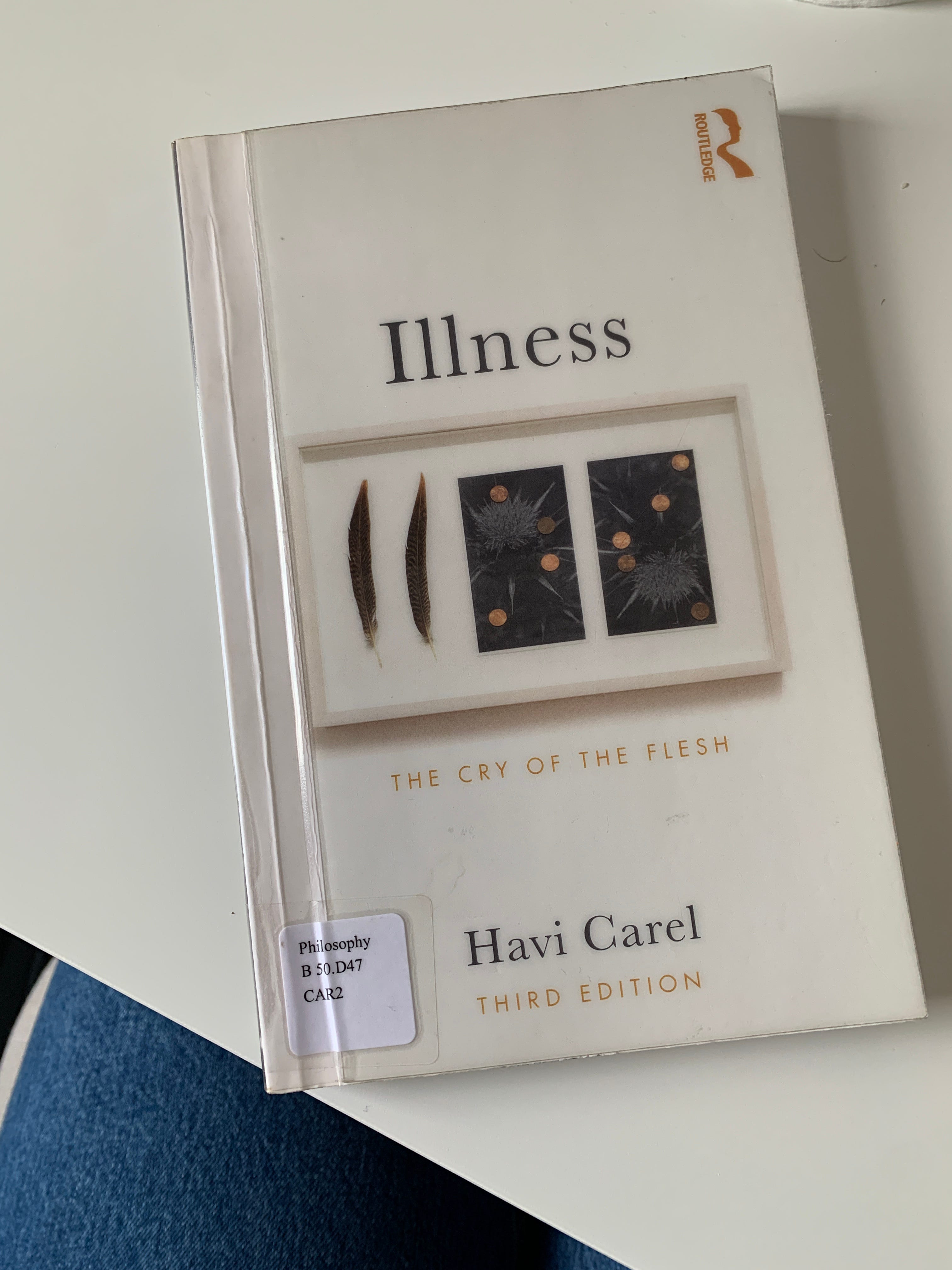
Illness (3rd ed. 2019) by Havi Carel is a philosophical exploration of illness, grounded in Carel’s own experience of a life-limiting lung disease. The book raises philosophical questions for us all, whether ill or not, on our fear of death, living in the present, and what it means to live a good life. She argues for phenomenological approaches to illness rather than empirical, objective takes, in both philosophy and medicine.
Phenomenology privileges the first-person experience, thus challenging the medical world’s objective account of disease. … On the phenomenological account, illness is no longer seen merely as biological dysfunction to be corrected by medical experts. Because of phenomenology’s focus on the subjective experience of the ill person, it sees illness as a way of living and experiencing the world. (Carel, 10)
Reflections on the text
I copy a passage into my journal, applying it to my own situation. It introduces me to a concept, though not meant to describe my type of illness, that resonates with me and is helpful. Adding this into my Substack post, I resist the thoughts of my inner critic and imposter parts who suggest this is misappropriation, and instead choose to honour the passage as generative to further thinking and philosophising.
The internal experience of doubting and examining one’s interoceptive (sensitivity to stimuli originating inside of the body) sensations and beliefs is a constant and exhausting activity. It is part of a phenomenon called “interoceptive hypervigilance” - constant scanning of one’s sensations and bodily input… (Carel, 153)
I reflect on how menstrual cycle tracking, as a way to live with PMDD, and the awareness I’ve gained about my internal landscape since my CPTSD diagnosis, have led to my own interoceptive hypervigilance. My version, however, consists of monitoring not only physical symptoms but micro changes in mood and mindset too. And I can attest that it is indeed a ‘constant and exhausting activity’. Yet I am always wondering why I am persistently fatigued.
I resist the guilt I feel for lamenting my own conditions when faced with Carel’s discussion of life-threatening and life-shortening illness, and remind myself that there is no hierarchy of suffering. That my experience of illness is not any less valid. Much of what Carel describes and proposes applies to chronic, non-life-threatening illness too, and she often gestures to chronic illness in the book. But some of the text’s concerns, like organ transplantation and death are distinctly related to life-threatening illness and so I wonder: do we need different descriptors for illness as a chronic, disabling ‘condition’ versus illness as life-threatening ‘disease’? Chronic illness does not seem distinguishing enough as a term, as it surely encompasses both life-threatening and non-life-threatening illnesses.
Much of the text thinks through ‘health within illness’ and this is an important and encouraging framework. Part of my own journey since being diagnosed with PMDD has been reconstructing a notion of ‘health’ in the face of chronic illness. Similar to the discourse on defining your own version of success, finding our unique definitions of ‘health’ is empowering. Any time we get to refine and redefine parts of our lives is an opportunity to get closer to living in a more authentic, freer way. Furthermore, in redefining ‘health’ we disrupt ableist, capitalist, productivity-driven systems.
Carel invokes Laurie Paul’s conception of the ‘transformative experience’ and poses organ transplantation as a transformative experience.
A transformative experience, suggests Paul, is an experience that changes you in two ways. A transformative experience changes you epistemically - it gives you knowledge, insight, and understanding you could not have gained otherwise. For example, to make a rational choice about whether you’d like to become a parent, you need to know what it is like to be a parent. But to know that, you need to become a parent. … A transformative experience also changes you personally. Your values and preferences, what matters to you and what your goals are may change radically … Whatever you find out about yourself and however you are transformed by the experience, positively or negatively, cannot be known or anticipated in advance. (Carel, 155-56.)
The notion of transformative experience seems applicable to my own experience of illness, as well as the experience of ‘becoming’ ill or of diagnosis more broadly. It offers an interesting framework for reflection for all of us who become ill, although it does rub up against problematic tendency to read acquired disability through the lens of ‘before and after’.
I have not yet concluded whether it is my ‘becoming ill’, or rather my becoming aware that I was ill, or my diagnoses, that count as my transformative experience but I know that somewhere in my experience of illness is this transformative experience from which I gained so much more of myself, of what matters, that I wouldn’t otherwise have gained.
My final takeaway is in Carel’s consideration of philosophy as therapy. She claims that philosophy provides ‘guidance in everyday life’, is ‘a practical aid to life’ and a ‘tool to reflect on and enhance well-being’. This sentiment resonates with me and I have had my own transformative encounters with theory and philosophy, where it has left me with the sensation of being ‘saved’ by it, or it has healed (at least something in) me.
Journal prompts
What would your phenomenological contribution be to the philosophy of illness, based on your experience of illness?
What does ‘health within illness’ look like for you?
Reflect and journal on a ‘transformative experience’ in relation to the quote in point 4. What knowledge and insights did you gain from it? How were you changed in ways that you wouldn’t otherwise have been?
If philosophy is therapy, which philosophers/texts have been your therapists? How did they help you?
Havi Carel, Illness: The Cry of the Flesh, 3rd edn., (Oxon and New York, NY: Routledge, 2019)
Laurie Paul, Transformative Experience, (Oxford: Oxford University Press, 2014).
If this resonated with you, I’d love to work together more deeply. I offer workshops and 1:1 tutoring that combine literary study with personal reflection and self-care practices. Learn more about working with me → laurencooper.me